
Problem Statement
Coring through reinforced concrete requires precise avoidance of reinforcement, tendons, and embedded services. Inadequate targeting risks structural damage, costly repairs, and safety incidents. A non-destructive, high-resolution method was needed to quantify rebar spacing, cover depth, and bar layout to define a safe coring window.
Overview
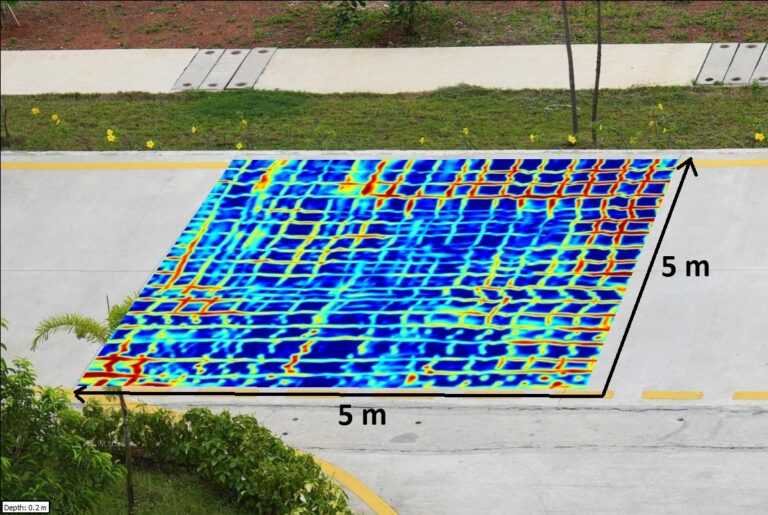
A high-frequency UWB GPR survey (≈500 MHz bandwidth ~250–750 MHz) was performed over the proposed coring zone. Objectives: (i) map rebar grid geometry, (ii) measure bar spacing and concrete cover, (iii) confirm absence of utilities/tendons in the intended core footprint, and (iv) designate a safe, centered coring location with tolerances.
Methodology
- Survey design: Dense parallel lines (≤5–10 cm spacing) in two orthogonal directions for true grid reconstruction.
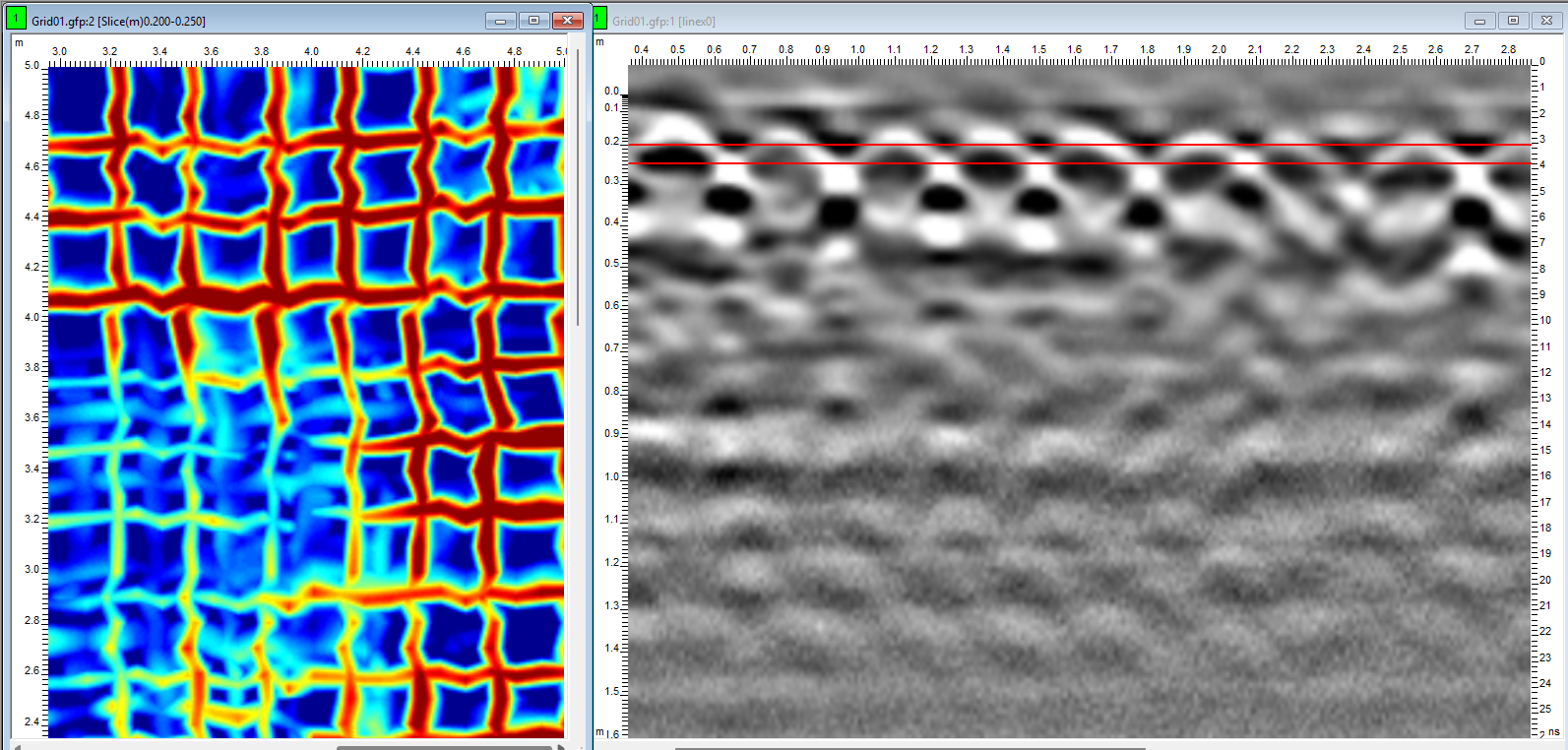
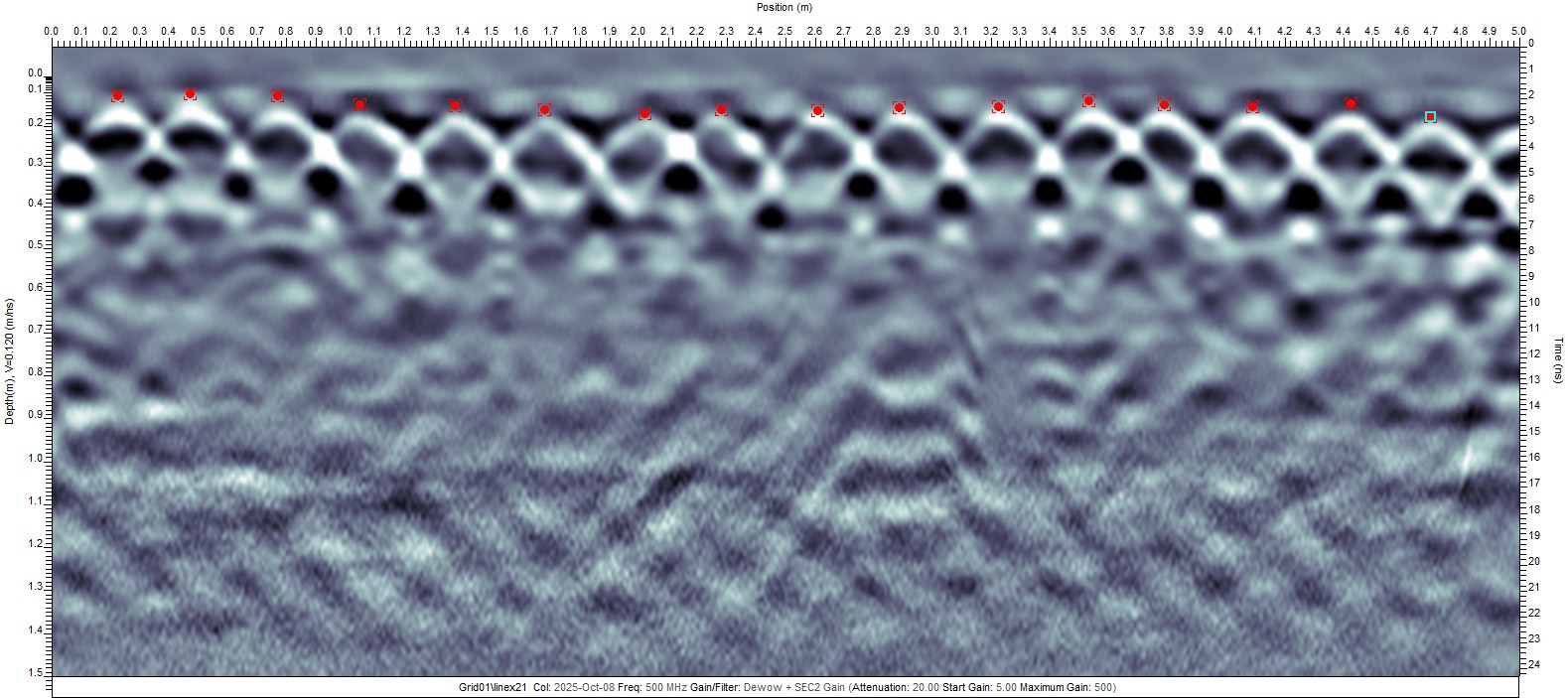
- Processing: Background removal, bandpass, migration, attribute/amplitude analysis; time–depth conversion via dielectric calibration (from known slab thickness or on-site calibration target).
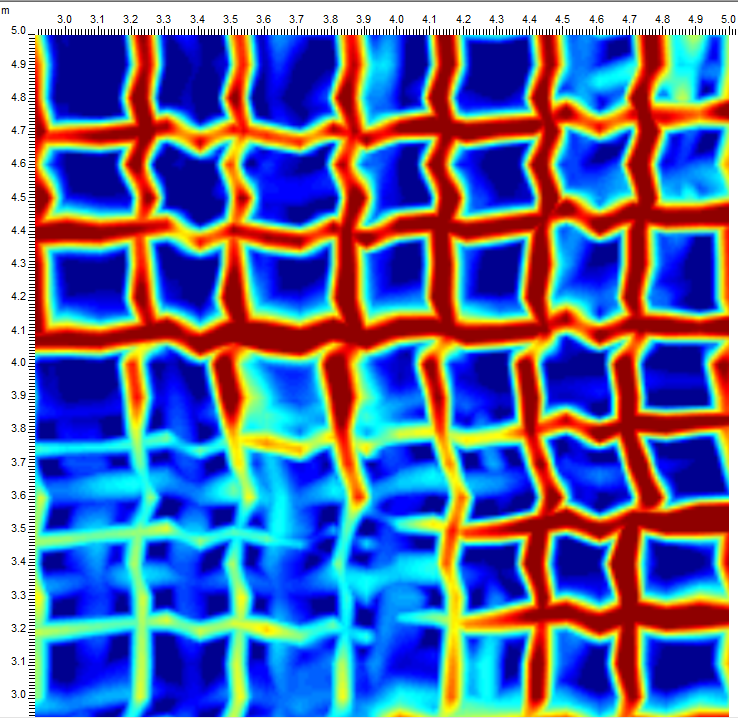
- Analysis: Hyperbola fitting to estimate bar positions/diameters, compute center-to-center spacing, cover depth, and produce plan-view depth slices marking bar centrelines and no-core zones.
- Screening: Focused passes to rule out post-tension (PT) ducts, conduits, or anomalies within the proposed core diameter + safety buffer.
Key Findings
- Rebar layout: Orthogonal mesh resolved with consistent spacing (e.g., ~150–200 mm c/c typical; site-specific values reported) and cover depth variability quantified (±5–10 mm).
- Clear windows: Multiple rebar-free corridors identified; the optimal coring point centered mid-span between adjacent bars with ≥1.5× core radius clearance to nearest bar.
- No services detected: No GPR signatures indicative of PT tendons or utilities within the buffered core footprint.
- Tolerance box: A marked core window (e.g., Ø100 mm) with ±15 mm placement tolerance defined on the slab surface; relocation rules provided if tolerance exceeded.
Engineering Impact
- Enables safe, non-destructive core extraction while preserving structural capacity.
- Provides as-built rebar map and measurements for QA/QC and records.
- Reduces risk of striking reinforcement/services, minimizing downtime and repair costs.
- Supplies inputs for material testing (e.g., compressive strength, chloride) with documented structural clearance.
Conclusion
High-density UWB GPR reliably resolved rebar spacing, cover, and clear zones, allowing a precisely located, low-risk core cut. The workflow couples quantitative spacing/cover metrics with a field-marked tolerance window, offering a repeatable, audit-ready approach to coring in reinforced concrete.
Let's Build the Future With Us
Whether you are a researcher, startup, industry partner, government organisation, academic institution, or student, IITTNiF provides opportunities to innovate, collaborate, develop technologies, and create national impact.