

Deep Subsurface Profiling and Geological Interface Mapping Using 50 MHz GPR
Problem Statement
Understanding subsurface geological layering and bedrock variations is essential for site characterization, groundwater studies, and infrastructure planning. A low-frequency GPR investigation was conducted to evaluate deeper subsurface reflectors and geological variations beneath the lawn area in front of AB1 Building, IIT Tirupati.
Overview
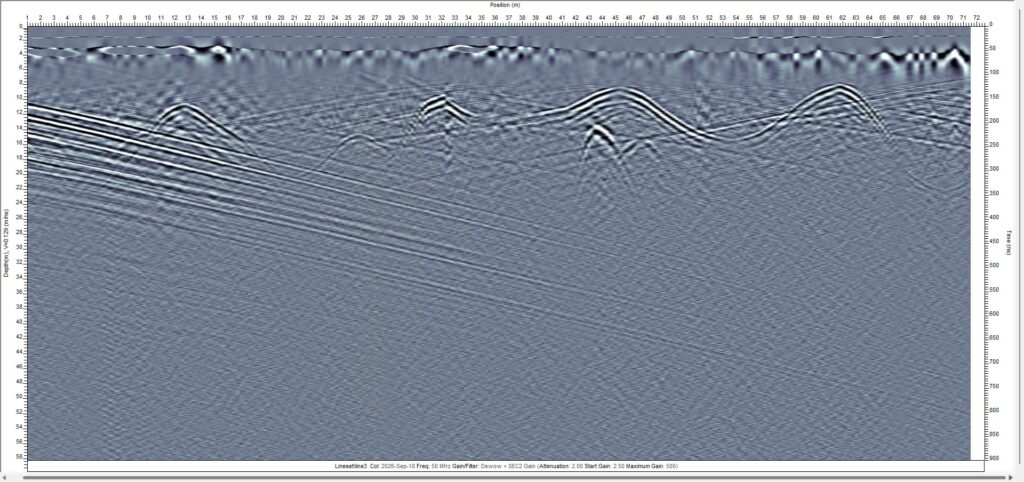
A 50 MHz GPR survey was carried out across the lawn area in front of AB1 Building to investigate deeper subsurface structures. The survey provided continuous subsurface profiling to identify prominent reflectors, geological interfaces, and variations in subsurface materials.
Methodology
- A 50 MHz low-frequency GPR antenna was used for deeper subsurface investigation.
- Continuous reflection profiling was conducted across the lawn area.
- Radar data were processed using filtering, gain adjustment, and background removal to enhance subsurface reflectors.
- Prominent reflection patterns were interpreted to assess subsurface layering and geological variations.
Key Findings
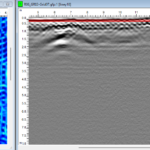
- Subsurface Layering: Prominent continuous reflections indicate distinct subsurface interfaces.
- Geological Variations: Inclined and undulating reflectors suggest lateral variations in subsurface materials.
- Deeper Reflectors: Continuous reflection patterns were observed extending into the deeper section of the radar profile.
- Subsurface Characterization: The radargram provides insights into subsurface stratification and potential geological boundaries.
Engineering Impact
- Supports preliminary geological and subsurface characterization.
- Provides continuous subsurface information across the surveyed lawn.
- Assists in understanding subsurface material variations for future site investigations.
Conclusion
The 50 MHz GPR survey successfully imaged subsurface reflectors beneath the lawn in front of AB1 Building, IIT Tirupati. The observed continuous and inclined reflection patterns provide valuable insights into subsurface layering and geological variations, demonstrating the applicability of low-frequency GPR for deeper subsurface investigations.
Let's Build the Future With Us
Whether you are a researcher, startup, industry partner, government organisation, academic institution, or student, IITTNiF provides opportunities to innovate, collaborate, develop technologies, and create national impact.